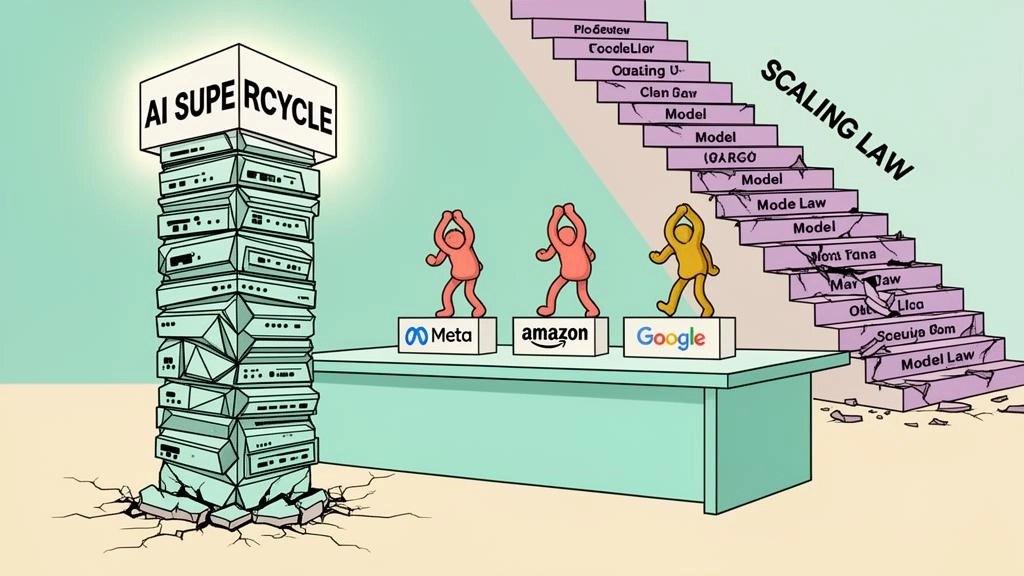
Artificial intelligence (AI) is comprehensively reshaping the investment logic and industrial competitive landscape of global capital markets. Goldman Sachs' latest report points out that the rapid iteration of AI technology is spawning a capital expenditure supercycle led by the private sector, with corporate profitability set to become the key driver for subsequent stock price appreciation. At the same time, Qualcomm CEO Cristiano Amon unveiled an ambitious blueprint for entering the data center and AI inference chip markets, preparing to transform from the king of mobile chips into a full-scenario AI computing power supplier. However, CICC offers a different perspective, warning that AI bubble risks may not lie on the demand side but rather in the business model concerns at the model level.
Goldman Sachs: Capex Supercycle Takes Shape, Stock Selection Over Market Timing
As large language models (LLMs) and various AI technologies develop rapidly, enterprises are facing unprecedented capital demand pressure. In its latest investor report, Goldman Sachs explicitly points out that to satisfy the insatiable thirst for AI system infrastructure and computing power, global enterprises are significantly expanding capital expenditures. This is not merely a simple technology upgrade but also involves strengthening supply chain resilience and responding to geopolitical risks.
The Wall Street giant defines this phenomenon as a new growth engine driven by private investment. Goldman's analysis shows that for the first time in decades, capital demand is experiencing such significant accelerated growth. Coupled with governments simultaneously increasing defense and critical infrastructure spending, capital levels across multiple industries are being pushed to new heights. However, this environment presents a double-edged sword effect for financial markets: higher borrowing costs may suppress stock valuations, making strong earnings growth the decisive factor driving stock price performance.
Goldman Sachs strategist Ben Snyder emphasized in a June 12 report that record corporate profitability has become an important pillar supporting high U.S. stock valuations. Data shows that the seven tech giants — including Nvidia (NVDA), Microsoft (MSFT), Google (GOOGL), Amazon (AMZN), Meta (META), Apple (AAPL), and Broadcom (AVGO) — currently achieve a combined return on equity (ROE) of 44%, a significant increase of 9 percentage points compared to three years ago.
In this wave of AI spending enthusiasm, Goldman believes semiconductor manufacturers are the biggest beneficiaries. Strong demand combined with supply constraints has pushed their profitability to historic highs. Goldman notes that the semiconductor industry's net profit margin is approaching 50%, primarily attributable to strong pricing power and solid competitive moats.
In contrast, hyperscale cloud service providers are facing heavy capital burdens. Goldman estimates that by 2026, capital expenditure by major cloud service providers will reach approximately $770 billion (about NT$24.3 trillion), a figure equivalent to roughly 100% of their operating cash flow. However, with improving revenue expectations, increasing customer order backlogs, and margin expansion, AI investments are beginning to show returns. Against a backdrop of intensifying earnings divergence, Goldman advises investors to focus more on individual stock selection rather than simply allocating to broad-based indices.
Qualcomm: From Mobile Chip Dominator to AI Computing Power Challenger
Just as market attention focuses on the AI infrastructure arms race, Qualcomm, long dominant in smartphone system-on-chips (SoCs), is attempting to shed its "mobile chip company" label. Qualcomm President and CEO Cristiano Amon recently revealed to CNBC that the company is participating in the design and development of over 40 new AI terminal devices, fully preparing for the impending "AI Agent" super wave set to explode in consumer electronics.
In the interview, Amon painted a new picture of future consumer electronics, listing wearable devices such as smart jewelry, earbuds with built-in cameras, brooches, and smartwatches. The core principle of these products is to "always be with you, see the world around you, possess contextual awareness, allowing you to instantly call upon and converse with an AI agent." He stated bluntly that apps will not disappear, but AI agents will become the new application platform, and the center of future digital life will shift from smartphone screens to agents that can understand human intent and proactively handle tasks.
Among all new form-factor terminals, Amon is particularly bullish on AI smart glasses. He disclosed that current global smart glasses annual shipments have reached the "tens of millions" level, with the potential to reach hundreds of millions of units in the coming years — market potential possibly as large as the smartphone market. According to data from research firm Counterpoint Research, global smartphone shipments last year were approximately 1.26 billion units, with annual growth of only about 3%, showing clear deceleration, while giants like Meta, Samsung, and OpenAI have already entered the AI wearable device market.
In response to device miniaturization and always-on AI demands, Qualcomm is comprehensively upgrading its technology roadmap. Amon acknowledged that existing devices are not yet ready for ubiquitous AI integration, and the next-generation Snapdragon platform needs to strike a balance between stronger AI computing power and extreme energy efficiency. Since April this year, Qualcomm's stock price has surged approximately 75% cumulatively, with its market capitalization stabilizing around $233 billion (about NT$7.3 trillion). The logic behind this is no longer just about mobile chip cyclicality, but rather the market repricing its potential core position across two main AI computing power tracks: "data center CPU/custom AI inference chips + on-device AI agent devices."
On the data center side, Qualcomm has confirmed its return to the server CPU market, developing custom data center CPUs based on its self-developed Oryon core, compatible with Nvidia's NVLink Fusion interconnect architecture. For AI inference workloads, Qualcomm has introduced AI200 and AI250 accelerator solutions, based on its proprietary Hexagon NPU architecture optimized for memory capacity and energy efficiency, planned for large-scale commercialization from late this year to early 2027. These rack-level inference platforms emphasize low total cost of ownership (TCO), directly challenging the deployment positions of Nvidia and AMD in large-scale AI infrastructure. Institutional analysts point out that enterprises are viewing agentic AI as "powerful cost-reduction and efficiency-enhancement capex." MarketsandMarkets estimates that the global AI agent market could reach $53 billion (about NT$1.7 trillion) by 2030, with a compound annual growth rate as high as 46% from 2025.
CICC Warns: Bubble Risk Lies Not in Demand, But in Model Business Models
However, behind the capital euphoria, concerns are also emerging. CICC released a report noting that the market has recently focused excessively on the hardware segment, reflecting worries about massive capital expenditure and AI model competition uncertainty. The firm believes that hardware, models, and applications need to advance in tandem, and overly concentrated market movements inevitably carry the risk of intensifying bubbles.
CICC presents a unique viewpoint: AI bubble risk may not stem from demand itself, but from business model concerns at the AI model level. Specifically, the continuously increasing upfront R&D investment brought by Scaling Law, combined with excessively intense competition making it difficult for enterprises to establish differentiation barriers, means that under the dominant pay-per-use and subscription models, they may constantly face competitive challenges from low-price models.
Observing financial report data, increasing AI investment has already begun affecting corporate cash flow. In the first quarter of this year, the combined capital expenditure of Google, Meta, Amazon, and Microsoft grew 70% year-over-year, with some companies already supplementing funds through external financing. Pressure from depreciation, financing costs, and free cash flow may gradually become apparent in the future. CICC specifically highlights that cloud computing remains one of the clearest directions for current AI commercialization, with the four giants' combined cloud revenue growing 39% year-over-year in Q1 and order backlog surging 145% year-over-year — demand remains robust. Based on considerations of core business and valuation alignment, CICC prefers Meta (META) and Amazon (AMZN), believing their AI-side expectation gaps are more pronounced, while Google's (GOOG) current high valuation already implies relatively elevated market expectations.
From Goldman Sachs' capital expenditure supercycle thesis, to Qualcomm's aggressive positioning in edge and cloud inference markets, to CICC's sober warning on model business models, the AI industry stands at a critical inflection point where hardware infrastructure, terminal applications, and business models are locked in a three-way struggle. Whether the market can ultimately sustain new valuation premiums for AI infrastructure remains to be validated by substantial revenue contributions from data center product lines. But what is certain is that Wall Street has begun to take seriously this high-stakes gamble reshaping the global technology landscape.