Nearly $18 billion in bitcoin and ether options will expire on Friday, potentially reshaping dealer hedging flows and short-term volatility.
- Bitcoin’s $16 billion quarterly options expiry could remove a key source of buying pressure and trigger fresh volatility after settlement on Friday
- More than half of the expiry’s $9.4 billion in bitcoin call notional is in the money, while puts are almost entirely underwater
- Bitcoin’s rally through $80,000-$87,000 may have been amplified by dealer hedging, a source of buying pressure that could fade after settlement
Roughly $15.9 billion in bitcoin options and $2.1 billion in ether options expire at 8:00 UTC., according to Deribit CEO Luuk Strijers. The BTC expiry alone will shave off 37% of Deribit’s entire outstanding BTC open interest, around $43.5 billion as of this writing. Open interest here refers to the dollar value of active options contracts. Each contract represents one BTC or one ETH.
“This Friday's quarterly expiry Sept. 25 is one of the largest of the year on Deribit,” Strijers told CoinDesk. “The September contract remains call-heavy, with a put/call open-interest ratio of 0.69 — positioning that was built for higher prices.”
A call option is a derivative contract that gives the buyer the right, but not the obligation, to buy an underlying asset at a fixed price (the strike) by a set date (expiration).
Think of it as paying a $100 premium to reserve the right to buy a $1,000 laptop anytime in the next four weeks. If the laptop’s price jumps to $1,200, you exercise your right and effectively save $200 (minus your $100 token). If the price stays at or below $1,000, you let the reservation lapse and lose only the $100.
Traders use call options to profit from an impending surge in the underlying asset, in this case, BTC or ETH. Put options do the opposite by protecting the buyer from a potential sell-off in the underlying asset.
The crypto options market has expanded multifold since 2020, with traders combining call and put options alongside spot and futures positions to express views on price direction, volatility, and time decay. That surge has turned quarterly options settlements into must-watch events for crypto traders.
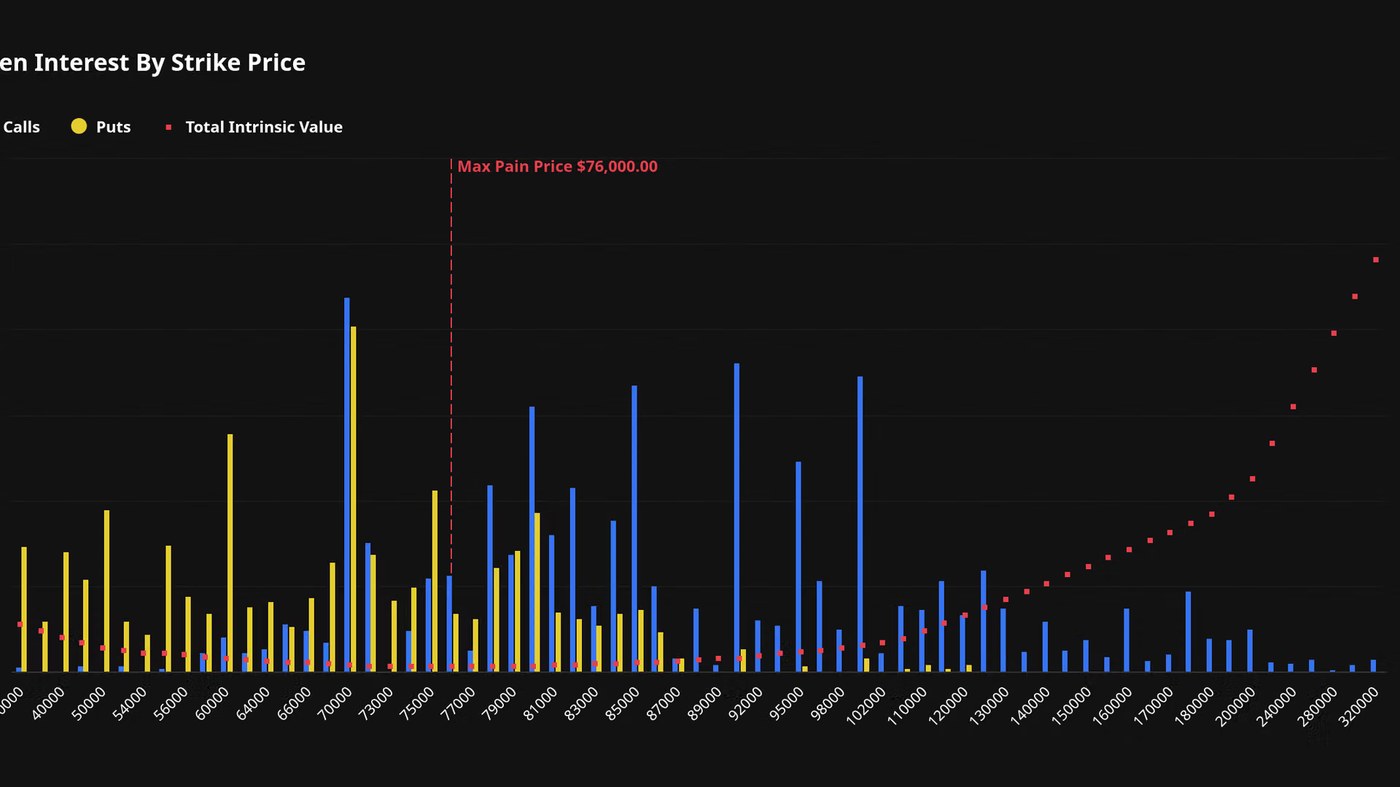
One thing traders widely track is max pain for expiries: the spot price level at which option buyers stand to lose the most on the day of expiry. The theory, though widely debated and challenged, is that options sellers seek to drive the spot price to the maximum pain point to inflict maximum pain on buyers.
The maximum pain for bitcoin is $75,000, well below the spot price of $85,500. Deribit described the level where option buyers collectively suffer the greatest losses as a “soft magnet for price into expiry.”
Open interest distribution
The $70,000 strike has more open contracts than any other, and the calls there are now deep in the money.
Strijers said 55% of the $9.4 billion in call bets due for expiry are in the money. Puts, meanwhile, are mostly worthless right now. Put it together, and about a third of the entire $15.9 billion book is currently in the money.
Being in the money means being in profit – an option has intrinsic value because the market price is on the favorable side of its strike. For a call, the underlying trades above the strike; for a put, it trades below the strike.
Deribit’s Chief Commercial Officer Jean-David Péquignot said the distribution of open interest across strike prices suggests a price floor around $75,000.
“Open interest is heavily concentrated at the $85k, $90k, $95k, and $100k call strikes, underscoring the ongoing influence of large 85k/90k/95k/100k call condor blocks that are now coming directly into play as spot trades near $86k,” Péquignot said. “On the put side, defensive structures are firmly anchored at $60k, $70k, and $75k, creating a multi-layered support floor.”
What happens on the expiry day?
Friday’s expiry could breed some market turbulence, eventually resetting the trading range for BTC’s spot price.
That’s because, as per Strijers, the expiry will clear out dealer-related hedging.
“As Bitcoin moved through the $80k–$87k area, dealer hedging of short call exposure likely contributed to the upward move: dealers who are short calls have to buy spot as prices rise to stay hedged, which adds fuel to rallies,” Strijers told CoinDesk.
“Once that gamma and hedging flow rolls off after settlement, the pinning effect fades, short-term volatility can increase, and the prevailing range can reset,” he added.
Separately, Strijers said traders will watch price action around $85,000 and how positions “rollover” into October and December expiries. Rollover means traders close or offset their current options positions and simultaneously open similar positions in a later-dated expiry.
As stablecoins move into regulated finance, APAC is becoming a key proving ground. This report maps the region’s rules, use cases, and RLUSD’s role.