- Published
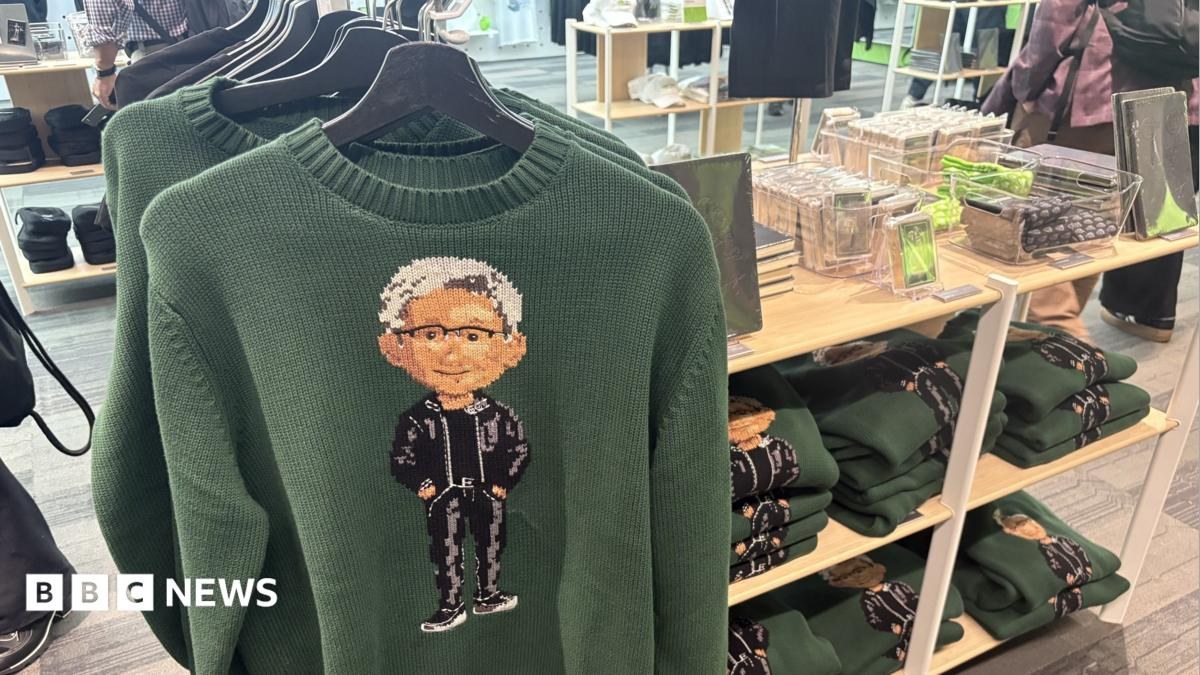
For Natalie Fratto, putting on her dark green jumper from US microchip giant Nvidia is like wearing the kit from a favourite sports team.
On the front of the $178 (£132) woollen garment is a cartoonish image of the tech company's boss Jensen Huang.
Fratto doesn't work for Nvidia. Instead, she's a fan of the company.
"I have a New Zealand All Blacks rugby jersey, and I think of my Jensen sweater in kind of the same way," says New York-based Fratto, who runs a tech start-up.
She explains that it's a representation of a team and ethos "that I am impressed by and root for", and she proudly wears the jumper in videos she posts on social media., external
Nvidia certainly plays in the top league of global tech firms. Under Huang's leadership, it has capitalised on the AI boom to become one of the world's most valuable companies.
While it sells tens of millions of its chips per year, its clothing is far more exclusive. The lines, which also include t-shirts, hoodies and hats, are typically only available to buy from pop-up stalls at its conferences, and for very limited periods or "drops" via an online store and sell out very quickly.
And while it might seem odd that such a tech company is selling clothing, others are getting in on the act too â and also focusing on exclusivity.
OpenAI, the operator of ChatGPT, usually only offers its branded fashion to employees, but occasionally it goes on general sale for a few days via its website.
Meanwhile, Anthropic, the maker of the Claude chatbot, last year opened a temporary, pop-up coffee shop in Manhattan's West Village. For just one week it gave away free baseball hats with the word "thinking" embroidered on the front.
Professor Hazel Clark, who teaches fashion at Parsons School of Design in New York, says that by limiting availability, tech firms have taken inspiration from the world of fashion. "It's a very common strategy for brands to use. It elevates the desirability," she says.
But why are such companies selling clothing in the first place? It is not as if they need the supplementary income streams.
Nvidia, OpenAI and Anthropic all declined to comment, but it appears to be about brand promotion and reputation management.
Take US software firm Palantir Technologies, which has faced criticism due to it work for the military and police, both in the US and overseas. Since launching its own clothing range last year, Palantir now calls itself a "lifestyle brand".
Eliano Younes, Palantir's head of strategic engagement, says: "A lifestyle brand isn't defined by what you sell, it's defined by what you stand for and whether people want to affiliate with it. I believe that the store's success and the enthusiasm from our community proves this."
Younes adds that "investors, customers, employees, and everyday people" in more than 60 countries have bought Palantir's gear, which includes a cotton jacket.
One US buyer of Palantir clothing, who didn't want to be named, says it was attracted by the controversy and "amount of people talking about it". He adds: "It's the purest form of anti-fashionâ¦and that is what makes it so interesting and unique."
Critics suggest companies like Palantir are using stylish merch "to get their name into a more positive conversations", as Clark puts it.
Younes says: "Our clothing, like our software, is not political. It's designed for all people who support Palantir and what it stands for."
Some other companies are being more overtly political with their clothing, such as US defence firm Anduril, which makes military drones. It sells a hoodie emblazoned with the words "Rebuild the Arsenal", reflecting its aim of seeing more US defence spending and manufacturing.
Jonathan Sargent, a legal assistant in Albuquerque, New Mexico, has bought clothing from both Palantir and Anduril. "A lot of apparel today, whether it's Nike or other large brands, can feel disconnected from anything tangible," he says.
"But Palantir and Anduril are companies that people associate with building things that have a visible impact, whether that's defence, AI, infrastructure, or decision-making systems," he adds.
Back at Nvidia, the popularity of its founder Huang may be driving the sale of its clothing. He has been known to attract crowds of adoring fans, competing for autographs or selfies with the 63-year-old who is known for his trademark leather jacket.
Meta CEO Mark Zuckerberg has described Huang as "Taylor Swift, but for tech".
Prof Gianpaolo Vignali of the Manchester Fashion Institute says: "People look at them [such big tech bosses] as role models. They want to aspire to them."
For Greg Epstein, author of the book Tech Agnostic, who describes the tech industry as a cult or new global religion, wearing tech merch is "a way of symbolising that you're one of the prophetic elite". This can particularly appeal to Silicon Valley insiders who are often "searching for a sense of identity, a sense of purpose, a sense of community".
Epstein, who is the humanist chaplain at both Harvard University and the Massachusetts Institute of Technology, adds: "When tech bros put themselves on sweaters, it's more than just a cutesy phenomenon, it's an attempt to sell a cult whose goal is to radically alter the human condition."
Whether or not you choose to buy your next shirt or hat from a tech or defence firm, Vignali argues that all clothing choices are loaded with meaning. "The subtle colour of a tie or hair bobble⦠all of these are signals that allow the wearer to symbolically share their cultural and ideological positions," he says.
While tech and defence fashion seems to draw both ardent fans and fierce critics, not everyone takes it so seriously.
"It's a unique moment in our collective zeitgeist for sure," says Fratto, but she also thinks that Nvidia's decision to put Jensen Huang on the front of its official merch is also "kind of funny".
Read more global business stories
-
- Published3 September
-
- Published27 August
-
- Published6 August